Master the Market: Why Even Seasoned Pros Need a 2026 Closing Resource List
The real estate landscape has fundamentally shifted. If you are a seasoned agent who has spent the last fifteen, twenty, or twenty-five years navigating transactions based on grit, intuition, and a trusted local handyman, it is time for a serious reality check. The old playbook is no longer just outdated, it is actively dangerous to your business.
In 2026, real estate isn’t just moving faster; it is operating under an entirely new paradigm of automated municipal scrutiny, strict underwriting guidelines, and aggressive consumer protection transparency. Property data that used to sit undisturbed in dusty municipal filing cabinets for decades is now instantly cross-referenced by predictive artificial intelligence and title company data-mining scrapers the moment a listing hits the MLS.
Unrecorded liabilities, ancient building code anomalies, and dormant permit infractions that used to slide under the radar are suddenly being flagged as catastrophic "clouds on title" mere days before closing. If your closing strategy relies on reacting to these problems after the title company uncovers them, you aren't just risking delays—you are actively volunteering to watch your hard-earned commissions slip away against the clock.
To survive and thrive in this highly regulated environment, top-producing real estate professionals treat risk management as a proactive operational system. The absolute cornerstone of that system is a specialized, production-ready Closing Resource List. This isn't a casual list of local home inspectors and carpet cleaners pinned to a bulletin board; it is a dedicated, institutional tactical playbook designed to save transactions from collapsing at the eleventh hour.
What is a Closing Resource List?
A Closing Resource List is a curated, pre-vetted directory of specialized municipal, legal, and structural experts deployed the exact moment a transaction exhibits a compliance anomaly.
Think of it as an emergency triage system for your pipeline. Instead of scrambling frantically on Google when an underwriter halts a file, a Closing Resource List provides instant, predictable access to targeted problem solvers who understand the precise mechanics of transactional bureaucracy. It is the boundary line between an agent who panics and an agent who closes.
Anatomy of a 2026 Closing Resource List
To protect your volume in today's market, your resource matrix must include specific, deeply targeted technical assets. A standard general contractor simply does not have the administrative clearance or specialized municipal relationships required to fix modern compliance roadblocks.
Your updated playbook should feature these foundational categories:
1. Permit Resolution Experts
This is the single most critical asset missing from traditional vendor lists. When a property search reveals structural modifications, system upgrades, or ancient administrative open items, you cannot afford to send your clients to sit in a code enforcement lobby. You need dedicated professionals like Permit Resolution Services who specialize exclusively in auditing municipal histories, pulling historical blueprints, and resolving municipal clouds.
What they handle: Expired building permits, retroactive construction sign-offs, unpermitted footprint expansions, and municipal lien letters.
2. Specialized Code Consultants & After-the-Fact Expediters
Many homes boast beautiful renovations that were completed without bureaucratic oversight years before your client bought the property. When an appraisal or inspection reveals these hidden structural additions, standard contractors will often tell you to tear the work down. An expediter knows how to navigate localized amnesty programs and secure retroactive compliance without destroying the home's layout.
What they handle: Garage conversions, unpermitted accessory dwelling units (ADUs), structural patio enclosures, and historical zoning variances.
3. Structural & Civil Engineers (Closing-Oriented)
When a home inspector flags a structural anomaly, getting a general contractor's opinion rarely satisfies an underwriter. You need a certified professional engineer (PE) who can issue official, stamped structural certifications on an accelerated timeline.
What they handle: Foundation movement, load-bearing wall modifications without documented plans, and settling cracks.
4. Modern Title & Escrow Logistics Partners
The closing process shouldn't feel like a relic of the 1990s. Your list must feature tech-forward settlement providers capable of executing secure digital wire verification, remote online notarization (RON), and automated title pipeline alerts.
What they handle: Remote closings, wire fraud prevention, and real-time document tracking.
The 2026 Regulatory Reality: What You Don't Know Will Kill Your Deal
Let’s address the elephant in the room:Why should a seasoned agent with a pristine track record care about updating their vendor list right now?
The truth is, the macro-environment has changed in ways that experience alone cannot overcome. Relying purely on traditional methods introduces severe vulnerabilities due to structural shifts implemented across municipal landscapes over the last few years:
Automated AI Underwriting Enforcements: National underwriting conglomerates have integrated deep-learning document scrapers into their risk assessment suites. These tools instantly match county property appraiser data against historical MLS listing photographs from five or ten years ago. If the old MLS text mentioned a "fully finished bonus room" but the county tax roll still lists the space as an "uncovered back patio," an automated red flag is generated instantly. Financing is frozen before a human underwriter even looks at the file.
The End of the "We'll Clean It Up Post-Closing" Era: Seasoned pros are intimately familiar with the old method of handling minor permit issues: establishing a small financial escrow holdback and promising the buyers that the seller will close out the permit after funding. In 2026, strict title insurance standards and heightened risk aversion mean underwriters are increasingly rejecting escrow holdbacks for unresolved open structural or trade permits. They demand a clean municipal record prior to closing—no exceptions.
The Proliferation of Municipal Amnesty Deadlines: Municipalities across the state are aggressively cracking down on unrecorded structures to recoup tax revenue. Local building departments are introducing strict, hyper-specific code amnesty windows (such as the recent Pinellas County Permit Amnesty initiatives). If you aren't actively tracking these rolling local deadlines, you miss crucial windows to save your clients thousands of dollars in compounding code enforcement fines.
The Financial Math: Making More Money by Saving More Time
Many agents view building an advanced resource list as an administrative chore. In reality, it is a direct optimization strategy for your business's profit-and-loss statement.
Let's break down the operational economics of deploying specialized permit and compliance partners:
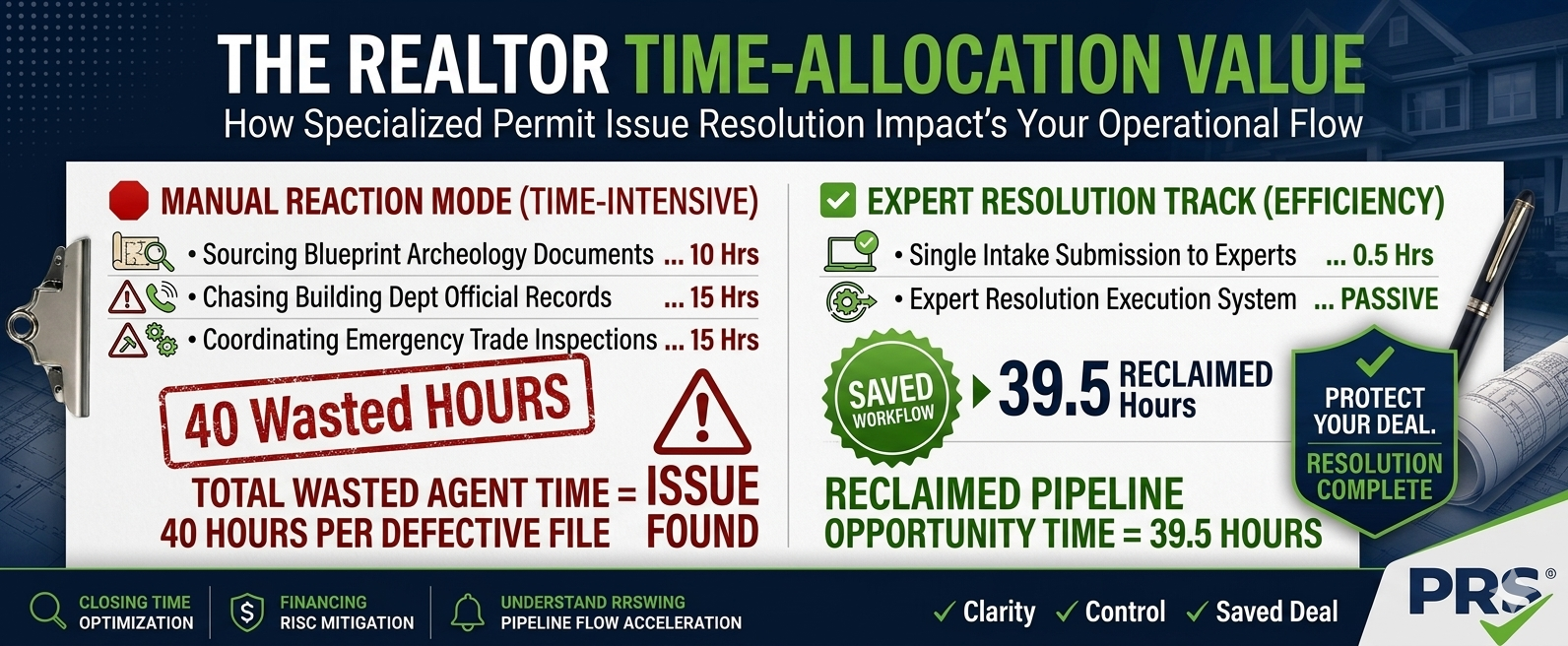
When you attempt to solve a permit or code crisis yourself, you are acting as an incredibly low-paid administrative clerk. Spending forty hours calling building departments, tracking down historical roofing documentation, or begging mechanical inspectors for a favor pulls you completely out of your core competency.
Those forty hours should be spent on high-leverage, revenue-generating activities: cultivating listings, hosting strategic viewings, and converting high-net-worth clients. By outsourcing compliance tracking to professional resolution groups, you buy back your calendar.
Exponential Lifetime Value (LTV)
Furthermore, protecting your client from an unexpected permit nightmare doesn't just save the current commission, it cements your status as an elite, unflappable market authority. When a buyer or seller witnesses you deploy an expert team to quietly eliminate a major structural title cloud within 48 hours, you secure a client for life. That flawless execution turns into unsolicited referrals, glowing digital case studies, and a dominant regional reputation that beats out discount competitors every time.
Turn Risk into a Competitive Advantage
The real estate market of 2026 has no sympathy for agents using outdated strategies. Experience is a powerful asset, but only when it is matched with modern execution systems.
Stop viewing permit checks and compliance audits as unexpected obstacles that disrupt your workflow. Instead, look at them as an opportunity to demonstrate absolute operational mastery over your market.
By integrating dedicated compliance experts like Permit Resolution Services directly into your Closing Resource List, you insulate your commission pipeline from sudden late-stage surprises. You protect your client's equity, save dozens of hours of administrative frustration, and ensure that every deal you fight for makes it safely across the finish line. Don't wait for an aggressive underwriting audit to break your next transaction, update your playbook, fortify your vendor network, and claim total control over your closings today.