Florida Title Guide: 7 Permit Red Flags Before Closing
7 Permit Red Flags Every Title Company Should Watch For Before Closing
In the fast-paced world of Florida real estate transactions, settlement agents and title examiners shoulder a massive burden. Ensuring a property possesses a clear, marketable title requires digging beneath surface-level deeds to unearth latent municipal liabilities. While traditional title searches excel at identifying recorded liens, mortgages, and judgments, a dangerous blind spot remains: unrecorded municipal permit violations.
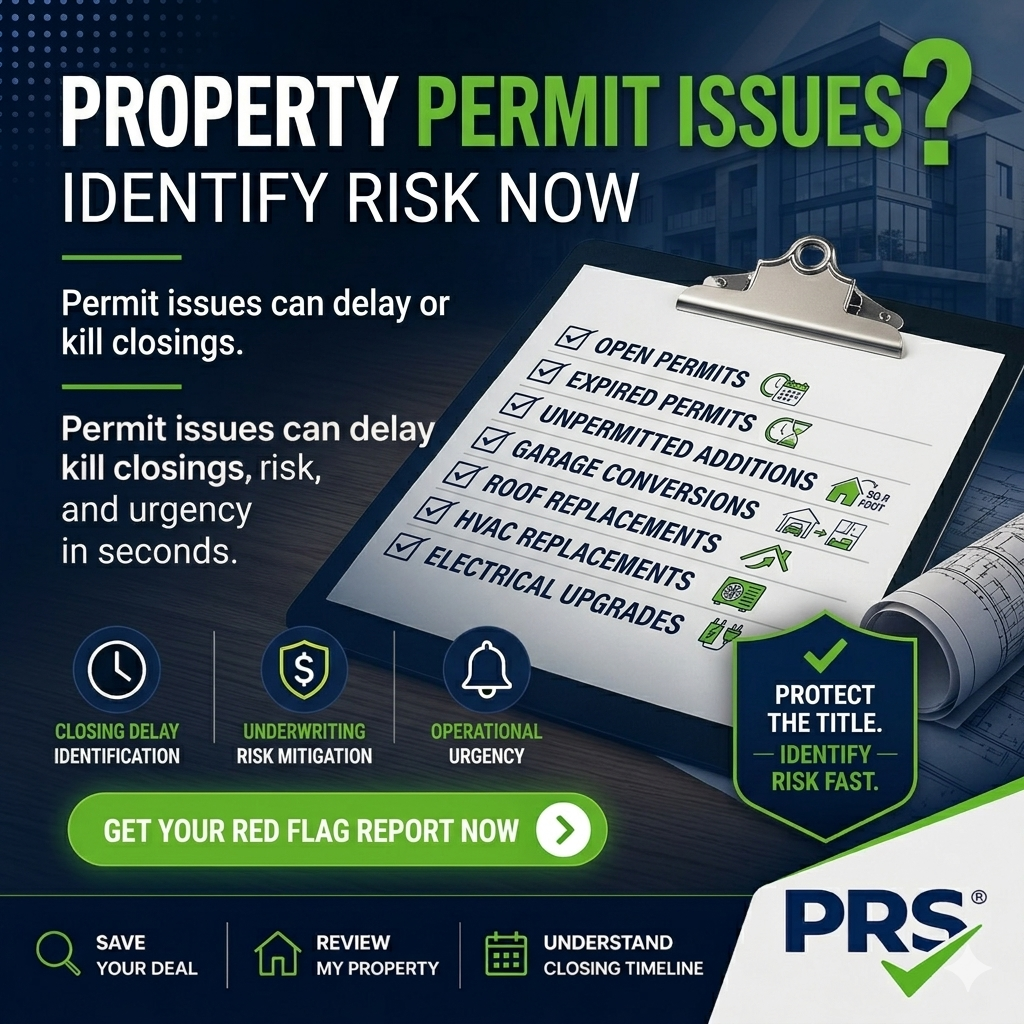
Across Florida’s high-velocity housing markets, from dense coastal tracts in Pinellas County to sprawling developments in Hillsborough and Pasco counties, unresolved permits routinely wreck closing timelines, trigger massive municipal fines, and compromise title insurance policy underwritings.
When a title company overlooks an open or expired permit, the systemic financial and legal liabilities do not disappear; they transfer directly to the incoming homebuyer. This leaves the title agency exposed to errors and omissions (E&O) claims, disgruntled clients, and strained relationships with real estate partners.
To insulate your settlement team and guarantee a smooth path to compliance, Permit Resolution Services (PRS) has compiled the seven critical municipal permit red flags that every Florida title company must evaluate before executing closing files.
1. Open Municipal Permits
An open permit occurs when a contractor or homeowner successfully initiates a building project with a local municipal authority but fails to secure the mandatory final inspections or local engineering sign-offs.
In jurisdictions like St. Petersburg, Clearwater, and Largo, open permits act as immediate red flags on municipal lien letters. The local building department considers the construction incomplete, meaning the structural integrity, safety, and code compliance of the work have never been verified by a certified municipal inspector. Lenders will routinely halt funding requests the moment an open permit is flagged, demanding that a certificate of completion be filed before any capital changes hands.
2. Expired Building Permits
Building permits are statutory mechanisms with strict operational lifespans, typically expiring 180 days after issuance if no active progress inspections are logged. This is one of the most common title impediments discovered during property due diligence in Pinellas County.
An expired permit means the work may have been completed, but because it lacked a final inspection before the expiration window slammed shut, the permit went dormant. Reviving an expired permit is an administrative nightmare. Municipalities often levy retroactive fees, impose code penalties, and, worst of all, require the completed work to be re-inspected under current, stricter building codes rather than the codes active when the project began.
3. Unpermitted Additions and Structural Footprint Expansions
During a review of Multiple Listing Service (MLS) historical notes or property appraiser tax profiles, your closing team might notice a clear structural mismatch: a property listed as a 4-bedroom, 3-bathroom home that is officially recorded on county tax rolls as a 3-bedroom, 2-bathroom asset.
This structural discrepancy indicates an unpermitted addition. Whether it’s an enclosed lanai, a structural bump-out, or a secondary story built without municipal review, unpermitted footprints present extreme risk. Florida building officials retain full statutory power to issue stop-work orders, levy recurring code enforcement citations, or mandate complete structural demolition to satisfy setback boundaries.
4. Illegal Garage Conversions
Turning an attached or detached vehicular garage into an auxiliary living quarter, a master suite, or a short-term rental unit is incredibly common across tourist-heavy regions like Clearwater Beach, Dunedin, and Tarpon Springs. However, a vast majority of these conversions are completed completely off-market without corresponding building permits.
For title companies, an illegal garage conversion violates local zoning ordinances regarding mandatory off-street parking minimums and structural density parameters. Furthermore, because these spaces rarely receive proper electrical or fire-safety mechanical sign-offs, they pose an ongoing property hazard that standard hazard insurance underwriters will refuse to cover, instantly blocking conventional residential financing tracks.
5. Unpermitted Roof Replacements
Florida’s strict tropical weather patterns mean roof structural longevity is a top priority for underwriters and lenders. A complete roof tear-off and replacement requires a mandatory building permit, structural underlayment tracking filings, and wind-mitigation validations.
If a title examiner discovers a roof was replaced within the past decade but finds no corresponding municipal filing, it’s an immediate red flag. Unpermitted roofs can prevent the new buyer from securing a standard property insurance policy at closing, which derails closing timelines on the spot.
6. HVAC Upgrades Without Trade Permits
Replacing a central climate control system or heating unit requires mechanical trade permits to verify appropriate electrical loads, refrigerant safety levels, and proper energy code compliance. In hot, humid sub-tropical climates like Tampa, Brandon, and Palm Harbor, mechanical system turn-over is exceptionally high.
When a property seller utilizes an unlicensed handyman to drop in a new condenser unit without a permit, they create a dormant compliance problem. Local code enforcement divisions can force retroactive engineering certifications or require system modifications to meet regional guidelines.
7. Unverified Electrical Upgrades
Upgrading a home’s electrical service panel, such as transitioning from an outdated fuse box to a modern 200-amp circuit breaker system—requires strict electrical permit controls. Electrical work completed outside the municipal pipeline is a leading cause of property fire risks.
Title professionals must treat unvetted panels as high-risk title exceptions. Lenders will refuse to sign off on underwriting guidelines until a licensed electrical contractor evaluates the framework, pulls an after-the-fact permit, and secures an official city or county validation stamp.
Establish Clear Resolution Strategies with PRS
When municipal red flags surface within ten days of your closing date, scrambling to fix them through bureaucratic channels can paralyze your operations. This is where Permit Resolution Services (PRS) steps in as your dedicated compliance partner.
Based in Pinellas County, Florida, PRS serves as the premier real estate resolution expert across the entire state. We handle the complex legwork of municipal permit research, permit closure, after-the-fact permitting, and code violation correction. Our experienced advisors coordinate directly with local building officials, municipal code boards, structural engineers, and field inspections to formulate an absolute path to compliance.
Don’t let an open or expired permit delay your transaction or compromise title policy protections. If your title search reveals a compliance issue, instantly cross-reference your findings against our Permit Risk Toolto assess delay timelines, underwriting risks, and structural urgency parameters in seconds.
Frequently Asked Questions (FAQs)
Can a title company close on a Florida property with an open permit?
Technically, yes, but it requires the title underwriter to explicitly create an exception to the title policy, which shifts all municipal risk and code enforcement liability to the buyer. Because most conventional mortgage lenders refuse to finance a property with open title exceptions, resolving the permit before closing is almost always required to preserve the transaction.
How long does it take to close or fix an expired permit in Florida?
The timeline varies wildly depending on the specific city or county municipality (e.g., Pinellas County vs. Pasco County or specific cities like St. Petersburg). A straightforward mechanical or roof closeout might take 5 to 10 business days, while complex after-the-fact permitting for unpermitted structural modifications can take weeks or months due to engineering and structural review workflows.
What is an after-the-fact permit?
An after-the-fact permit is a retroactive compliance mechanism that allows a property owner to legalize construction work that was previously completed without a building permit. It requires submittal of as-built architectural layouts or engineering reviews, structural field inspections, and payment of municipal penalty fees to officially resolve the code violation.
Need Urgent Help Clearing a Title Block?
Connect with the specialized title support division at Permit Resolution Services today.
Email: info@resolvemypermit.com