
What Happens When an Open Permit Threatens a Real Estate Closing?
It is the call every real estate agent, title closer, and loan officer dreads. You are seventy-two hours away from settlement. The buyers have signed their preliminary disclosures, the moving trucks are packed, the escrow account is wired, and the commission is practically sitting in your bank account. Then, the final municipal lien search or a late title update hits your inbox with a glaring red exception: an open, expired, or unresolved building permit from 2018.
Suddenly, a transaction that was gliding smoothly toward the finish line stalls out. The underwriter halts the clear-to-close, the buyer's lender pauses funding, and the entire deal is held hostage by a piece of administrative bureaucracy that everyone assumed was settled years ago.
If you operate in the modern real estate ecosystem, this isn’t a rare horror story—it is becoming a standard operational hazard. To protect your pipeline, your clients, and your reputation, you need to understand exactly what happens beneath the surface when an open permit threatens a closing, why the modern environment has made this problem so acute, and how to execute an immediate rescue plan.
The Immediate Domino Effect: Why an Open Permit Freezes a Deal
When a municipal records search uncovers an open or expired permit, it isn't just an administrative technicality; it triggers an immediate chain reaction across multiple contract dependencies. Understanding this domino effect is crucial to diagnosing how much time you have left to save the file.
1. The Title Insurance Standstill
A title insurance company’s core mandate is to issue a policy that protects the buyer and lender from future ownership challenges or unrecorded financial encumbrances. An open permit represents an incomplete municipal process. Because the local building department has not issued a final certificate of completion or certificate of occupancy, the municipality technically retains the right to fine the property, order structural code enforcement changes, or declare portions of the property uninhabitable. Consequently, title underwriters will list the open permit as a specific exception to coverage.
2. The Lender Funding Freeze
The moment a title company lists an open permit as an exception, the lender's legal counsel will immediately halt funding. No institutional mortgage lender will close on a loan where the title policy excludes protection against municipal code violations or incomplete permits. If the permit involves a major structural system, such as a roof modification, an electrical panel upgrade, or a structural addition, the lender’s automated risk assessment systems will categorize the property as an unacceptable collateral risk until the building department issues a clean bill of health.
3. The Contract Default Clock
As the closing date passes without funding, both buyer and seller enter a legally precarious gray area. If the financing contingency or title cure period isn't structured carefully, the buyer could find themselves in technical default for failing to close, or the seller could face legal demands to cure the title defect at massive personal expense. The timeline shifts from a cooperative closing environment to an adversarial battle against the contract clock.
The 2026 Shift: Why Old-School Fixes Are Blown Up At the Table
If you are a seasoned real estate professional, your immediate instinct might be to rely on the traditional quick fixes that saved deals a decade ago. However, structural and technological shifts implemented across underwriting and title networks have rendered the old-school methods entirely obsolete.
The Death of the Escrow Holdback
In the past, the standard remedy for a late-stage open permit was simple: create an escrow holdback agreement. The seller would leave $2,500 or $5,000 of their proceeds in the closing agent's escrow account, sign an agreement promising to close out the permit within 30 days post-closing, and everyone would fund the deal on schedule.
Under current insurance standards, underwriters are systematically rejecting escrow holdbacks for unresolved structural or trade permits. Why? Because municipalities have increased their enforcement severity. If an open permit for a roof or a structural addition cannot be closed due to an underlying structural defect, the cost to remediate the issue could skyrocket to $\$30,000$ or more, completely blowing past a minor escrow holdback and landing the title company in a massive insurance claim dispute. Lenders and title companies now demand a clean municipal record prior to funding, no exceptions.
Automated Municipal Cross-Referencing
Many open permits remain dormant for years because local building departments lacked the staff to audit old files. Today, local municipalities have updated their digital infrastructure, integrating automated databases that actively flag open items the moment a title company requests a municipal lien search letter. The data is shared instantly, removing the human buffer and forcing the violation into the light long before human intervention can massage the timeline.
The Operational Reality: The Hidden Pitfalls of the "Do It Yourself" Trap
When an open permit threatens a closing, many real estate agents attempt to solve the problem themselves. They drive down to the local building department, stand in line, and attempt to plead their case to a code compliance officer.
While well-intentioned, this manual DIY approach frequently backfires, creating severe secondary liabilities:
Waking a Dormant Giant: Walking into a building department to ask about an unfinalized permit from seven years ago can cause an administrative clerk to look closely at the file. If they realize an inspection was failed rather than simply forgotten, they may immediately issue a formal Code Enforcement Violation, initiating compounding daily fines that instantly trap the property's title.
The Sunk-Cost Time Trap: Chasing down historical blueprints, tracking down the original contractor who went out of business three years ago, and trying to decipher local building codes absorbs dozens of hours. While you are acting as an administrative clerk, your core lead generation pipeline completely stalls out.
The Strategic Solution: Deploying a Professional Resolution Track
To save a transaction threatened by an open permit, you must replace chaotic panic with an institutional system. Top-producing agents and sophisticated title professionals manage these crises by instantly outsourcing the friction to specialized compliance experts like Permit Resolution Services (PRS).
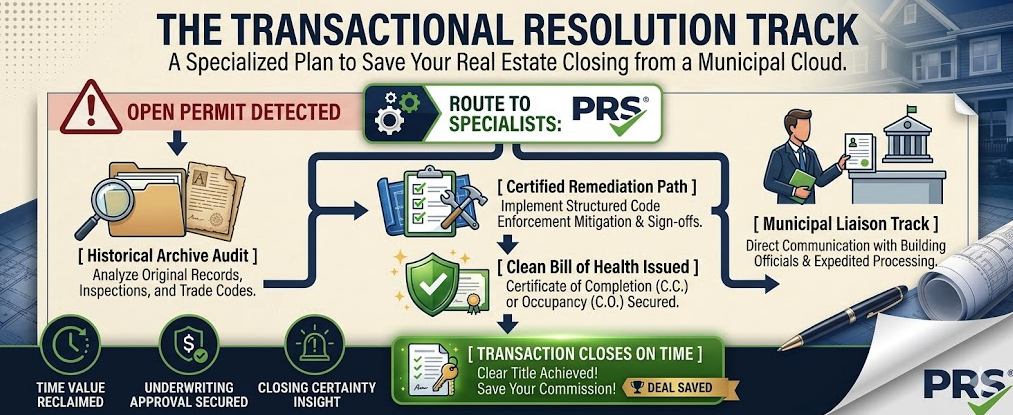
When a specialist takes over the file, they implement a structured, low-risk process to secure a clean title record without endangering the closing timeline:
Historical Archive Auditing: Instead of guessing why a permit remained open, experts pull the raw municipal history to pinpoint exactly which inspector visited the property, which specific trade code was flagged, and whether the issue is a simple paperwork omission or an uncompleted physical inspection.
Professional Municipal Liaison: Compliance experts speak the specific administrative language of local building departments. They know how to present files to building officials through established channels, often securing expedited review paths or retroactive structural sign-offs that a consumer or standard real estate agent wouldn't have access to.
Coordinated Closing Protection: By providing the title underwriter and lender with a formal, professional resolution plan from a certified third-party specialist, you can reassure the underwriting team that the issue is being resolved systematically. This clear communication often prevents the lender from killing the loan entirely, buying your transaction the crucial days it needs to cross the finish line safely.
Claim Control Over Your Pipeline
Open permits will always be a reality in real estate. But they do not have to be deal-killers. By understanding the modern mechanics of title underwriting, recognizing that old-school escrow fixes are gone, and integrating specialized resolution experts into your core deal-making workflow, you can confidently protect your pipeline, secure your commissions, and position yourself as an elite, unflappable risk manager in your market.
