Permit Issues Delaying Closing? What to do.
If you're a real estate professional in Pinellas County, you’ve likely experienced this scenario: everything is lined up for closing, financing, inspections, title, and suddenly a permit issue surfaces.
What should have been a smooth transaction becomes delayed, renegotiated, or worse falls apart completely.
In markets like St. Petersburg, Clearwater, Largo, Pinellas Park, Seminole, Dunedin, Palm Harbor, Tarpon Springs, Gulfport, and Safety Harbor, permit issues are not uncommon they’re expected. Many properties have undergone renovations over the years, and not all work was properly permitted or closed out.
The difference between a delayed deal and a saved deal comes down to one thing: knowing exactly what to do next.
Why Permit Issues Stop Deals in Their Tracks
Permit issues typically surface during:
Title searches
Buyer due diligence
Lender underwriting
Insurance reviews
And when they do, they introduce risk and uncertainty.
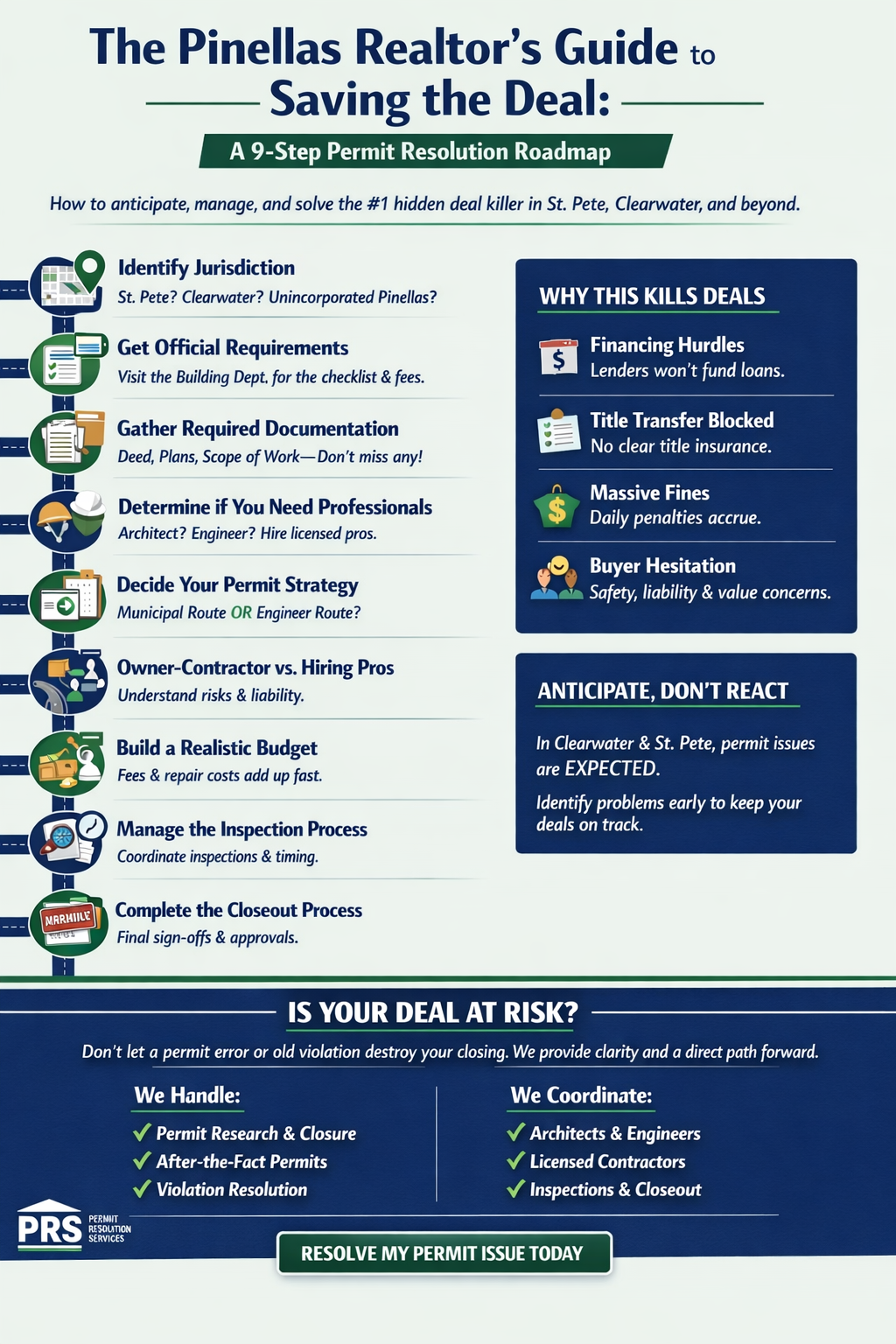
Common issues include:
Open permits that were never finalized
Unpermitted work (additions, conversions, etc.)
Expired permits with no inspections
Code violations or compliance issues
Mismatched property records
For lenders, buyers, and insurers, this raises concerns about:
Safety
Legal liability
Property value
Insurability
Step 1: Identify the Jurisdiction (Critical First Move)
Before anything else, you must determine:
✔What municipality or Authority Having Jurisdiction (AHJ) the property falls under
In Pinellas County, this could be:
City of St. Petersburg
City of Clearwater
Unincorporated Pinellas County
Or another municipality
Each jurisdiction has:
Different requirements
Different permitting processes
Different timelines
✔ This step alone determines how the entire situation will be handled.
Step 2: Get the Official Permit Requirements
Once the jurisdiction is confirmed:
✔ Visit the municipality’s Building Department (online or in person)
Request:
Permit application checklist
Required documentation list
Fee structure
This tells you exactly what will be required to move forward, and prevents costly mistakes later.
Step 3: Gather Required Documentation
This is where most deals slow down.
Permit resolution is documentation-heavy, and missing even one item can delay the process.
Property & Ownership Documents
Warranty Deed or Property Appraiser Record
Property Survey / Boundary Survey
Legal Description
Existing Structure Information
Site Plan (existing conditions)
Floor Plans (existing/proposed)
Elevation Drawings (if applicable)
Photos of completed work
Contractor & Construction Documents
Contractor agreements
Scope of work
Invoices and payment records
Subcontractor details
Permitting & Compliance Documents
Previous permits
Notice of Commencement
Engineering reports
Product approvals
Utilities & Trade Documentation
Electrical layouts
Plumbing plans
HVAC/mechanical details
✔ Missing documentation is one of the top reasons permit resolution drags out for months.
Step 4: Determine If You Need Professionals
This is where deals either move forward or stall.
You may need:
Architect
Structural engineer
Civil engineer
Licensed contractor
When this applies:
If drawings must be signed and sealed
If work must be corrected or completed
If inspections require professional verification
✔ Important:
If the municipality requires corrections, you must hire a licensed contractor in that jurisdiction.
Step 5: Decide Your Permit Strategy
Before submitting anything, you must decide:
Option A: Municipal Inspection Route
Standard process
No flexibility in scheduling
Slower communication
Option B: Engineer Inspection Route
More control
Potentially faster
Requires upfront planning
✔Key Rule:
Once your permit application is submitted, you cannot change this path.
Step 6: Owner-Contractor vs Hiring Professionals
Some property owners consider pulling an Owner-Contractor Permit.
This means:
You act as the general contractor
You manage subs
You handle inspections and compliance
BUT:
You must understand:
Construction best practices
Inspection sequencing
Financial responsibility
Legal liability
✔ This route is risky if you’re not experienced.
Step 7: Build a Realistic Budget
Permit issues are not just paperwork they have real costs.
Include:
Professional Fees (From design to inspections, our in-house architects, engineers, and inspectors handle every step needed to resolve permit and code issues quickly and efficiently)
Architect
Engineer
Surveyor
Inspector
Project Coordination
Permitting management
Inspection coordination
Closeout processing
Construction Costs
Repairs or corrections
Possible demolition to expose work
Municipal Fees
Often double for after-the-fact permits
Carrying Costs
Mortgage
Taxes
Insurance
Utilities
✔ Timeline matters this process can take weeks to months.
Step 8: Manage the Inspection Process
If permits require inspections:
Learn the municipality’s scheduling system
Understand inspection sequence
Coordinate contractors accordingly
✔ Missing inspections or failing inspections causes major delays.
Step 9: Complete the Closeout Process
This is the final—and often overlooked—step.
To officially close permits, you may need:
Contractor affidavits
Engineer certifications
Final sign-offs
Compliance approvals
In some areas:
Additional certifications are required (especially historic districts or special zoning)
✔ Without proper closeout, the issue remains and the deal stays at risk.
Why This Matters for Realtors in Pinellas County
Permit issues are one of the top hidden deal killers.
They:
Delay closings
Trigger renegotiation
Create financing issues
Cause buyer hesitation
Lead to deal cancellations
But here’s the key:
✔ Most permit issues can be identified early and managed strategically.
What to Do If Your Deal Is Already Delayed
If you’re currently dealing with a permit issue:
Act fast:
Identify the jurisdiction
Confirm the issue
Gather documentation
Assess risk
Bring in professional support
The longer you wait:
The more leverage the buyer gains
The higher the chance of losing the deal
Control the Outcome
In Pinellas County’s market, permit issues aren’t rare they’re part of the process.
The difference between average agents and top performers is simple:
✔They don’t react to problems they anticipate and solve them.
Need Help Resolving a Permit Issue?
Permit Resolution Services helps:
Realtors
Investors
Property owners
Title companies
We handle:
Permit research
Permit closure
After-the-fact permits
Violation resolution
And we coordinate:
Architects
Engineers
Contractors
Inspections
✔ If your deal is at risk, don’t wait get clarity and a path forward today. Get Started